

Understanding Gold Carats: Which One Is Right for You?
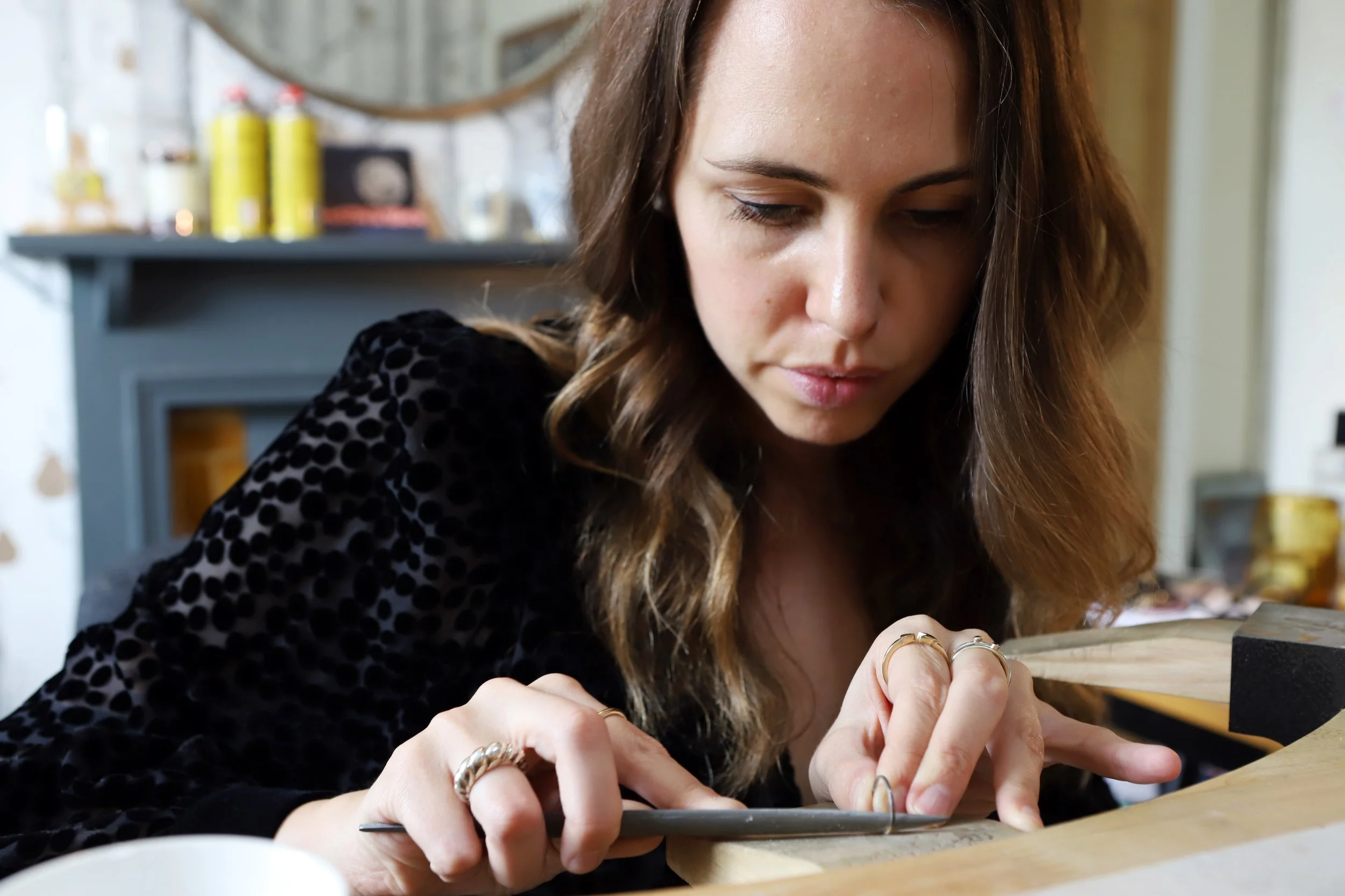
Goldsmith Katherine Elder working with precious metals at her North London studio bench
Almost every consultation I have eventually arrives at the same question: what carat should I choose?
Most people know that a higher number means “more gold” and, roughly, “more expensive.” Fewer people know why that matters beyond the price tag, or what's actually sitting in the rest of the metal alongside the gold. So this month, I wanted to properly explain it, because I think good jewellery starts with an informed client.
What the number actually means
Pure gold is measured in 24 parts. The carat tells you how many of those 24 parts are gold. 24ct is pure gold - soft, bright, rich and almost never used in jewellery because it dents and scratches too easily to survive real life.
Everything below 24ct is an alloy: gold mixed with other metals to change how it behaves. That's not a compromise. It's the whole point. The remaining percentage is a mixture of a selection of silver, copper, zinc, nickel, platinum and palladium. This is what gives a piece its actual colour, hardness, and character.
More copper in the mix pushes the colour warmer, toward a richer yellow or a rose tone. More silver pushes it paler and cooler, which is part of how white gold gets its colour. Two rings can be exactly the same carat and look quite different from one another, depending entirely on what they're alloyed with.
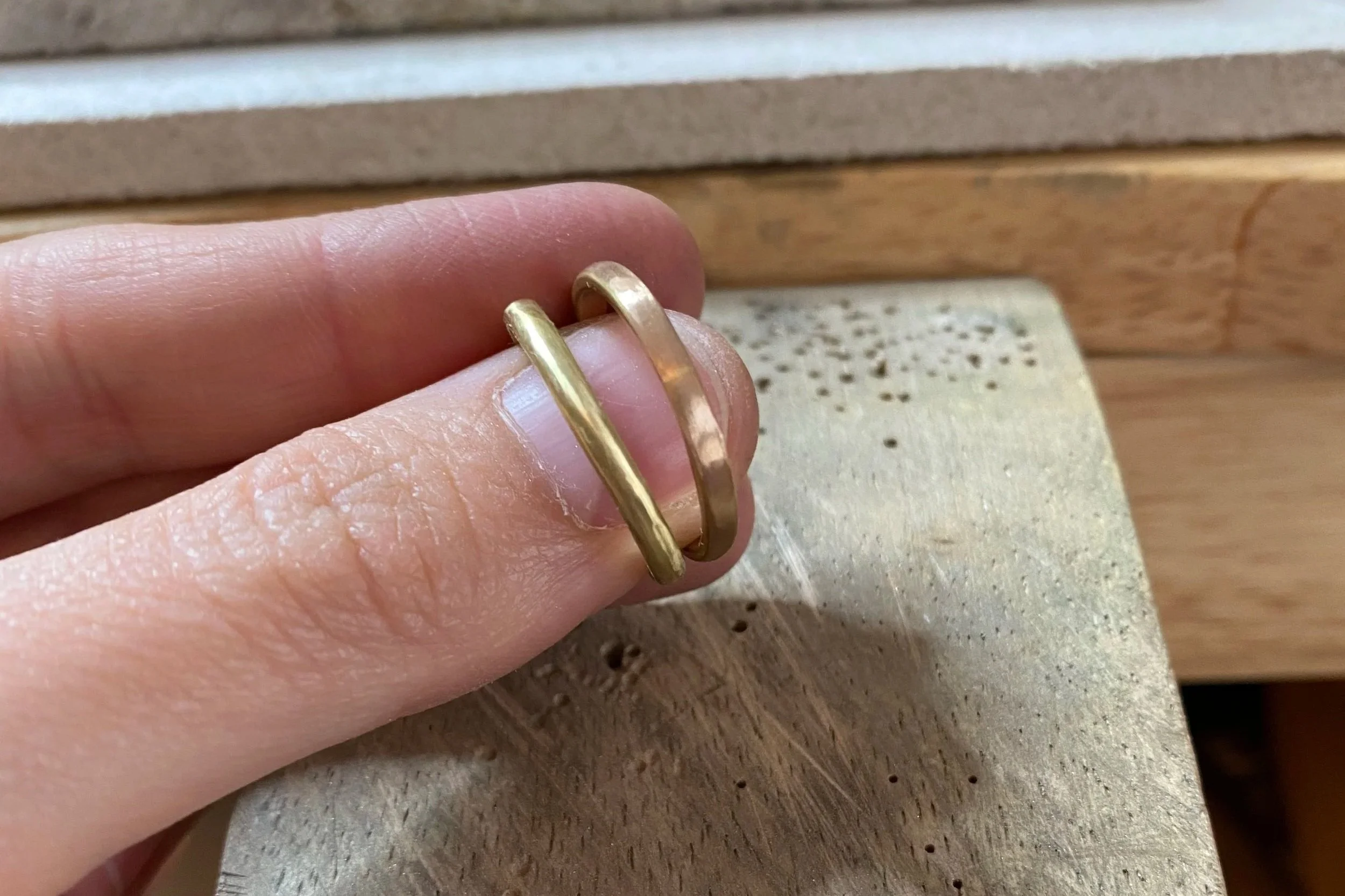
Comparison of 18ct yellow and rose gold colour and tone on the bench in Katherine Elder’s North London studio
The carats, one by one
24ct gold is 100% pure gold. It has the richest, deepest colour of any of the carats - nothing else looks quite like it - but it's genuinely too soft for jewellery meant to be worn and lived in. Its real value here is in its solid form as the benchmark everything else is measured against.
9ct gold is 37.5% pure gold - the minimum that can legally be called gold in the UK. It's the most affordable of the fine gold carats, and also the hardest-wearing, which makes it a genuinely good choice for pieces that get worn every day without much thought. The trade-off is a slightly less rich colour, and it can feel lighter in the hand than higher carats.
14ct gold sits at 58.5% pure gold. It's a middle ground I use often and with more depth of colour than 9ct, it still properly durable, and frequently the sensible choice for a client who wants something that feels special without the full cost of 18ct.
18ct gold, at 75% pure gold, is my favourite to work with, and the carat I reach for by default unless there's a good reason not to. It has a richness that lower carats simply don't, and it ages beautifully. This is the carat most fine jewellery, and most engagement rings, are made in for good reason. In my experience, a slightly softened, worn edge on an 18ct band after twenty years looks full of character and a life well lived in it.
22ct gold, at 91.6% pure gold, has a colour that's hard to match - deep, warm, glowing gold. I use it rarely. It's very soft and the metal marks easily even in normal wear. It tends to suit pieces with a strong, plain gold presence and no or a simple stone-setting involved, rather than anything that needs to withstand daily knocks.
None of these is objectively better than the others. They're suited to different lives, different pieces, and different budgets, and matching the right carat to the right brief is part of what a proper bespoke consultation is for.
How do you actually know what carat you're getting?
This is where hallmarking comes in, and it's worth understanding because it's your real guarantee, not just a nice stamp.
In the UK, any gold piece over 1 gram is legally required to be hallmarked by an Assay Office. There are only a few in the country, and they exist purely to independently test and verify precious metal.
A proper hallmark isn't decorative. It's a small cluster of marks, usually including the maker's own sponsor's mark (mine is registered with the London Assay Office), a mark showing the exact purity, and a mark identifying which Assay Office carried out the testing (London is represented with a Leopard’s head) a letter representing the current year of marking.
British hallmarking dates back over 700 years and it's one of the reasons I find this side of the craft so interesting. I recently designed a ceremonial piece for the Master of the Assay himself, which meant spending a lot of time researching the importantance of hallmarking and Assay Office’s profound responsibility of maintaining the purity, integrity, and trustworthiness of the realm's currency. I wanted the piece to serve as a reminder that true value - whether in metal, character, or nation - must be tested, proven, and protected.
Practically, it means you can trust what a hallmarked piece is made of without having to take anyone's word for it, including mine. If you ever buy gold jewellery without a hallmark, that's worth flagging and asking about.
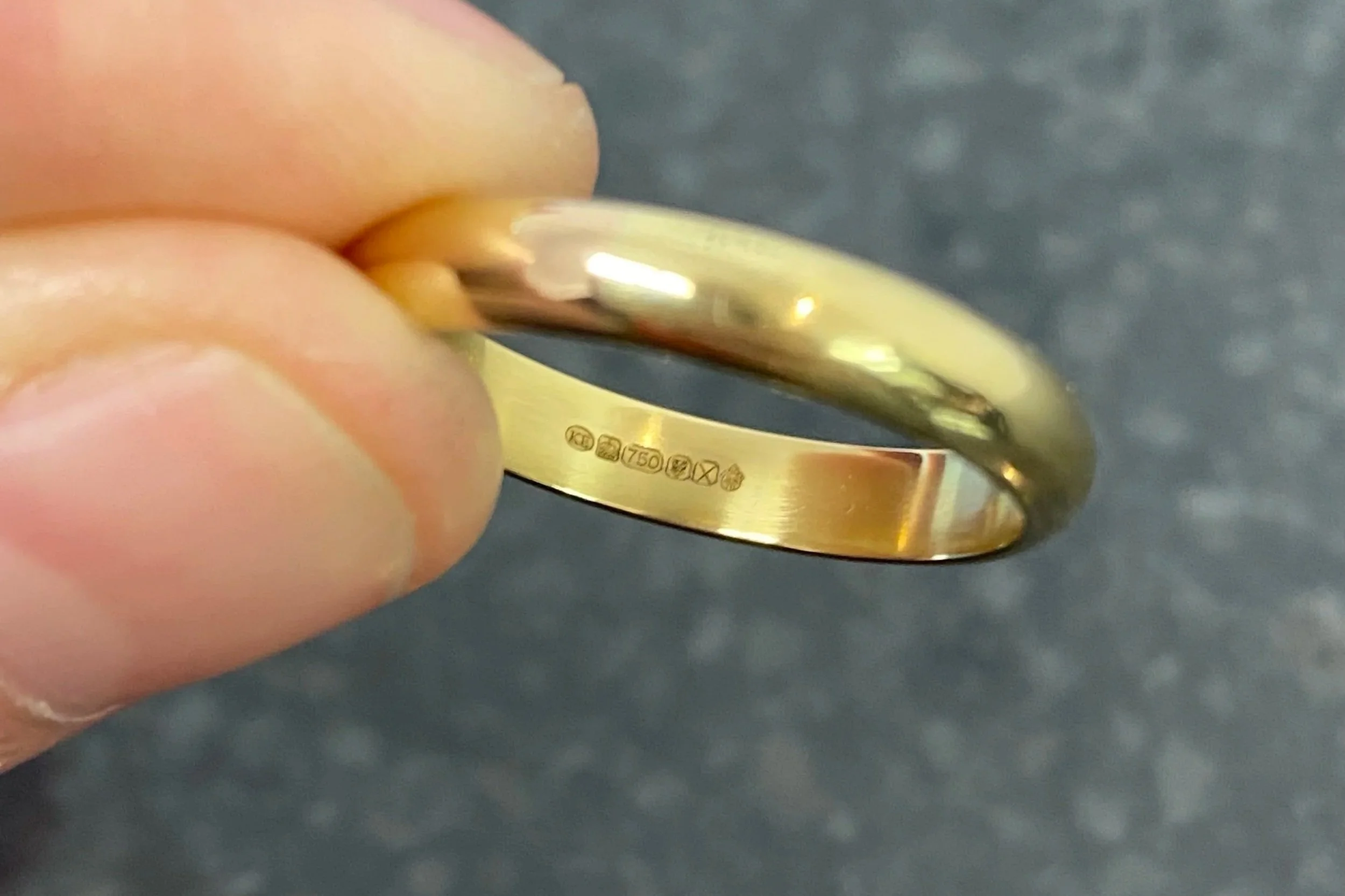
Close-up of Katherine Elder’s UK hallmark showing, from left to right, ‘KE’ sponsor's mark, ‘The Crown’ - metal type - gold, ‘750’ - carat -18ct, ‘Leopard head’ - assay office - London, ‘X’ - year stamped - 2022 and a rare, commemorative mark for Queen Elizabeth II’s Platinum Jubilee.
A practical note on ring stacks
If you're building a ring stack - the most common being engagement ring, wedding ring and eternity ring for example - metal and carat consistency is worth thinking about. A harder, lower-carat ring worn directly against a softer, higher-carat one will wear against the softer ring. It's slow, but it adds up over time and settings become unstable and shanks vulnerable. Keeping the carats matched across a stack is a simple way to avoid it and they sit next to each other more happily and any wear takes much longer.
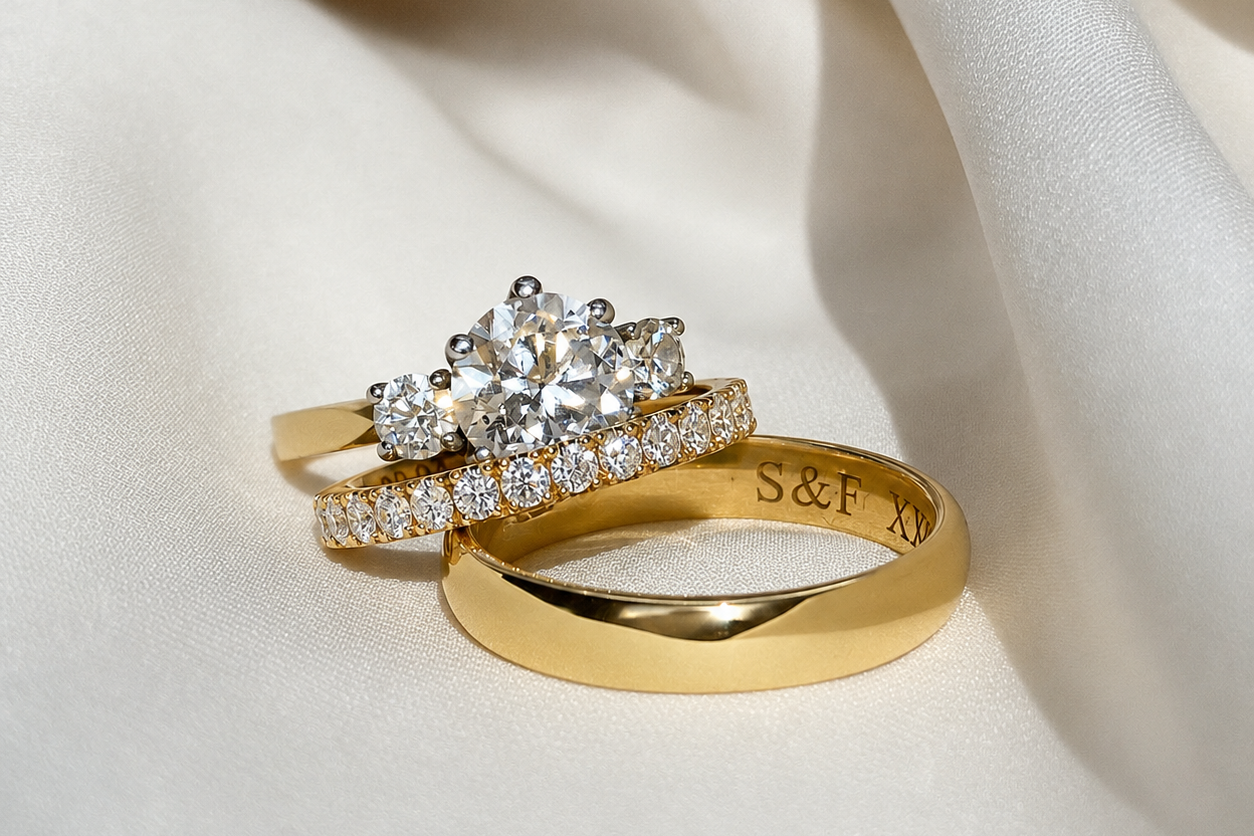
Bespoke Katherine Elder ring stack showing multiple 18ct gold rings - the trilogy engagement ring has a platinum setting to show off the white of the diamonds keeping the shanks all 18ct together.
Why this matters beyond the metal
I think this kind of detail gets skipped over a lot in fine jewellery, partly because it's easier to sell on carat number alone than to explain what it means. But as an independent jewellery designer in London, I think it’s my responsibility to make sure clients feel comfortable, informed and assured by having this conversation properly rather than leaving a client to guess, feel intimidated or insecure in a purchase.
It's also why every piece in my online shop can be made to order in a different carat to the one shown. If you've fallen for a design in 18ct but want the durability of 9ct for daily wear, or you want 18ct specifically to match an existing piece in your collection, that's a conversation rather than a compromise. This is one of the quieter advantages of choosing handcrafted jewellery from a North London studio over buying off a shelf: the piece can actually be built around how you live and personalised to your specifications.
In conclusion
There's no universally “right” carat. There's a right carat for a specific ring, a specific person, a specific way of living. That's the conversation I have with every bespoke client before a single sketch is painted, and it's one I'm always glad to have so please do get in touch, if you want to talk it through for a piece you had in mind of your own.
Thinking about a bespoke piece and want to talk through which carat suits it? As a bespoke jewellery designer in London, this is exactly the kind of conversation I love having - book a consultation or browse the shop, where every piece can be made to your preferred carat.